

Hey everyone, and welcome back to another educational blog post here on the Mixal blog! and today we’re tackling one of the first—and most critical—decisions you’ll make when launching a project online: choosing the right web hosting.
It doesn’t matter if you’re building a personal blog or a sophisticated e-commerce empire. The technical foundation of your site, its hosting, plays a fundamental role in its speed, security, stability, and ultimately, your visitor’s experience. Think of it as the digital land and foundation upon which you build your online home.
Our goal today is to cut through the technical jargon and give you a clear, straightforward guide to everything you need to know. By the end of this post, you’ll be able to confidently choose a hosting solution that not only meets your current needs but also empowers your future growth.
What is Hosting, Anyway?
So, what is a “host”? Simply put, web hosting is a service provided by companies that own and maintain the servers where websites live. This service includes resources like storage space, bandwidth, databases, and management tools. All the files that make up your website—images, text, code, and data—are stored on the host’s server. Thanks to hosting, your website can stay online and accessible to visitors 24/7.
Read More: What is Web Hosting?
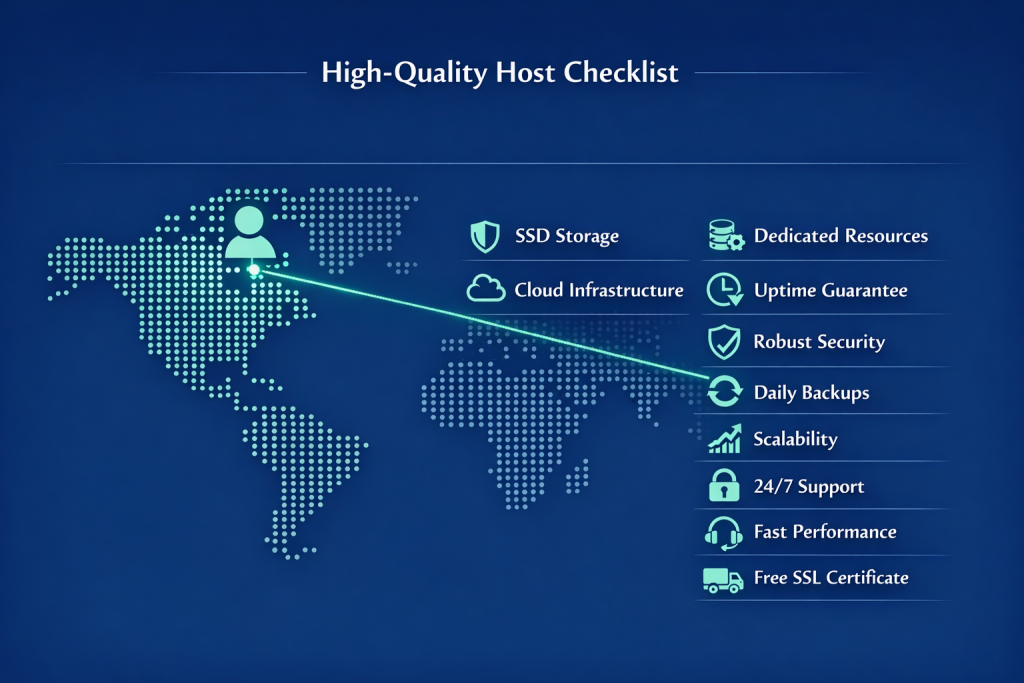
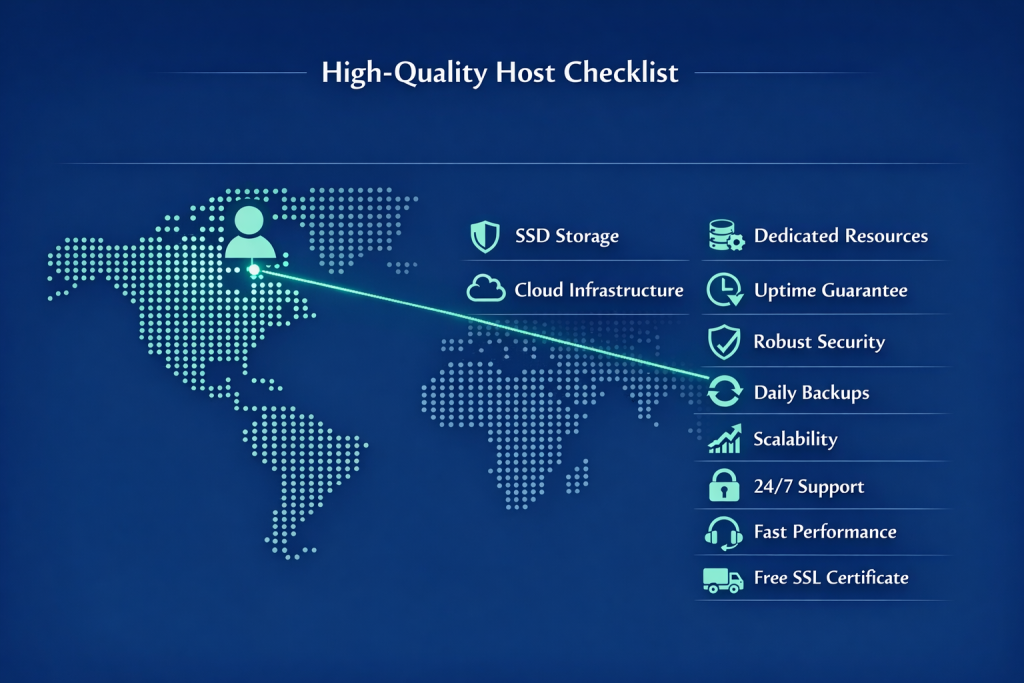
The Checklist: Key Features of a High-Quality Host
Great hosting is about more than just online storage space; it’s about the quality of the technical infrastructure supporting your site. The server’s hardware, allocated resources, and underlying technologies determine how fast, stable, and secure your website will be. Here’s a checklist of the most important technical features to look for:
1. SSD or NVMe Storage: Modern hosting should use Solid-State Drives (SSD) or, even better, NVMe SSDs. These drives dramatically increase data read/write speeds, which has a massive impact on your page load times. For data-intensive sites, a vps nvme ssd solution offers top-tier performance.
2. Dedicated Resources: A quality host will guarantee a certain amount of CPU and RAM for your site. This is essential for websites with high traffic or resource-heavy applications, ensuring your performance isn’t impacted by “noisy neighbours.”
3. Cloud Infrastructure: Hosting built on a vps server cloud architecture is inherently more stable, scalable, and resilient. If one server has an issue, your site is automatically failed over to another, preventing downtime.
4. Support for Modern Programming Languages: Up-to-date support for languages like PHP, Python, Node.js, and Ruby gives developers the flexibility to build and deploy modern applications without constraints.
5. Optimized Operating System: The server should run on an OS that’s right for your needs (e.g., a vps linux server is ideal for PHP and WordPress sites) and be properly configured for performance and security. Whether you need a Debian VPS server or an Ubuntu VPS server, the environment should be finely tuned.
6. High-Standard Data Centre: The physical data center where the server resides matters. Look for providers that use top-tier facilities with robust infrastructure, redundant power, advanced cooling, and strong physical security.
7. Regular, Automated Backups: The ability to schedule automatic daily or weekly backups is a non-negotiable feature for any professional hosting service. It’s your safety net against data loss.
8. Full DNS Management: Your hosting service should provide a simple and fast interface for managing all your DNS records (like A, CNAME, and TXT records).
9. Sufficient Bandwidth: A good host provides a generous amount of monthly traffic (bandwidth) without threatening to cut you off or throttle your speed if you have a successful month.
10. Easy Scalability: Your hosting should grow with you. Look for a service that allows you to instantly upgrade your resources (like adding more RAM, CPU, or storage) as your needs evolve. This is a key benefit of solutions like a dedicated vps.
11. Excellent Uptime & Stability: Above all, a host must be stable. Uptime is the measure of reliability; anything less than 99.9% is a red flag that your site could frequently be unavailable to visitors.
A Look at Top Hosting Providers in 2026
The global web hosting market is crowded, with countless companies offering services for every possible need. To make a smart choice this year, it’s helpful to compare some of the leading international players.
Mixal: The Ideal Choice for Performance-Focused Users
As a premier global provider of cloud computing services, we at Mixal offer a suite of solutions including Cloud Hosting, Canadian VPS Hosting, domain registration, and CDN services. With data centers in Canada and Europe, we are focused on delivering exceptional speed and security.
Cost: Competitive and scalable pricing tiers.
Data Centre Locations: Canada and Europe.
Best For: Startups, e-commerce stores, developers, gamers, and organizations seeking reliable, growth-oriented solutions.
Security: Automatic backup systems, robust firewalls, and included SSL certificates.
Key Advantage: Our focus on high-performance infrastructure, low-latency Canadian hosting options, and a dedicated, expert support team.
Hostinger: The Budget-Friendly Option with a Simple UI
In 2025, Hostinger became known as one of the most affordable yet powerful hosting services available. Its competitive pricing makes it attractive for beginners.
Cost: Very budget-friendly.
Performance: With a Load Contentful Paint (LCP) of around 0.6 seconds and 99.9% uptime, its performance is strong for the price.
Data Centre Locations: Europe, USA, Asia, and other regions.
Security: Weekly backups, free SSL, and DDoS Protection.
Key Advantage: Its simple, proprietary hPanel and the introduction of AI tools to simplify WordPress site management.
GreenGeeks: The Eco-Friendly Performer
GreenGeeks has carved out a unique niche by combining strong performance with a powerful commitment to the environment.
Cost: Mid-range to high.
Data Centre Locations: USA, Canada, Europe, and Asia, with global coverage via a free CDN.
Best For: Blogs, small businesses, WordPress sites, and eco-conscious brands.
Security: Free SSL, malware scanning, isolated environments, nightly backups, and a firewall.
Key Advantage: A 300% green energy match by purchasing renewable energy credits, registered with the EPA.
Bluehost: The Classic Choice for WordPress Sites
Bluehost is one of the most well-known names in hosting and is officially recommended by WordPress.org.
Cost: More expensive than budget options like Hostinger.
Data Centre Locations: USA.
Best For: WordPress sites, WooCommerce stores, and small to medium-sized businesses.
Security: Free SSL, SiteLock protection, and automated backups.
Key Advantage: Deep and seamless integration with WordPress and WooCommerce.
DreamHost: Stable Performance and High Transparency
DreamHost is another WordPress.org-endorsed provider known for reliable performance and transparent pricing policies, though it has experienced occasional service disruptions.
Cost: Affordable, with good value on annual plans.
Data Centre Locations: USA.
Best For: Personal sites, educational content, and WordPress projects.
Security: Free SSL, free domain privacy, and a web application firewall.
Key Advantage: Transparency on resource usage, a long money-back guarantee, and free daily backups.

A2 Hosting: Speed and Technical Support for Pros
A2 Hosting is renowned for being one of the fastest hosts available, with “Turbo” servers designed for developers and heavy websites. However, some users have reported dissatisfaction with renewal pricing in recent years.
Cost: Attractive introductory rates, but higher renewal prices.
Data Centre Locations: USA, Europe, and Asia.
Best For: High-traffic sites, developers, and professional applications.
Security: Free SSL, HackScan Protection, KernelCare, and malware scanning.
Key Advantage: Native support for technologies like Node.js, Python, and Git.
| Company | Competitive Advantage | Security | Recommended Use Case | Data Centre Locations | Cost |
| Mixal | Low latency, Canadian presence, rapid support | High (Backups, Firewall, SSL) | Startups, Developers, E-commerce | Canada & Europe | Competitive |
| Hostinger | hPanel interface, competitive pricing | Good | WordPress & lightweight sites | Europe, USA, Asia | Very Economical |
| Bluehost | Quick WordPress installation | Good | WordPress, E-commerce, Blogs | USA | Medium |
| DreamHost | Free backups, unlimited resources | Good | Content, Education, Personal | USA | Affordable |
| A2 Hosting | Extremely fast “Turbo” servers | Strong (HackScan) | Developers, High-traffic sites | USA, Europe, Asia | Medium to High |
| GreenGeeks | Green energy, environmental commitment | Reliable | Business & eco-friendly sites | USA, Canada, Europe, Asia | Medium to High |
Looking Beyond the Spec Sheet: How to Choose a Great Hosting Company
Once you’ve assessed your technical needs, it’s time to choose the company you’ll partner with. A provider must deliver quality resources, but the service experience is just as important. Here are the defining characteristics of a truly great hosting company.
Fast, Accurate, and Empathetic Support
Before you commit, investigate the company’s support reputation. Poor support can turn a minor issue into a major headache. Great support means rapid response times from a team that can provide expert technical solutions. They should listen patiently and work diligently to resolve your problems. When you’re choosing a host, prioritize a provider with a proven track record of excellent support.
A Rock-Solid Backup Policy
Website data is invaluable. In the event of a problem, a recent backup is your lifeline. The best hosting companies provide tools for you to create your own daily or weekly backups. Furthermore, the provider themselves should be taking regular, independent backups of their servers so they can restore your data in a catastrophic event. Don’t underestimate the importance of this feature.
An Uncompromising Stance on Security
Every business needs assurance that its data and its customers’ data are secure from cyber threats. A top-tier hosting company will invest in up-to-date, multi-layered security infrastructure. They should also give you the tools and permissions to install your own security applications and plugins.
Offering a Free Trial or Test Period
Reputable hosting companies often provide a way to test their services, sometimes through a free vps server trial or a money-back guarantee. This allows you to test your website on their infrastructure and experience their platform firsthand without financial risk. While these trial services may have limitations, they are an excellent way to gauge if a provider is the right fit for you.
Transparency in Pricing and Contracts
One of the biggest markers of a trustworthy hosting company is transparency. Some providers advertise a low initial price, only to add extra fees for essentials like SSL certificates, backups, or resource upgrades. The best companies lay out all costs and conditions clearly before you buy. Terms for cancellation, renewals, and refunds should be unambiguous. This transparency builds the trust that is essential for a long-term partnership.
A Proven History and Strong Reputation
Before you buy, look into the company’s history. Companies with a long track record often have more robust and stable operations. Beyond just age, check their reputation. Read reviews and testimonials on neutral, third-party sites. Real user feedback is often the best way to uncover a service’s true strengths and weaknesses.
The Complete Experience
Choosing a host isn’t just about comparing gigabytes and bandwidth. The real-world performance, page load speeds, network stability, and quality of the management tools are what truly matter. An intuitive control panel (like vps cpanel server), easy plan upgrades, and comprehensive documentation create a superior user experience. In truth, it’s this collection of crucial but non-technical factors that elevates a hosting company from acceptable to truly reliable. The best providers know that their job is to offer a full suite of services to ensure your success, from helping you buy a domain name in Canada to providing reliable email hosting in Canada.
A Quick Look at the Main Types of Hosting
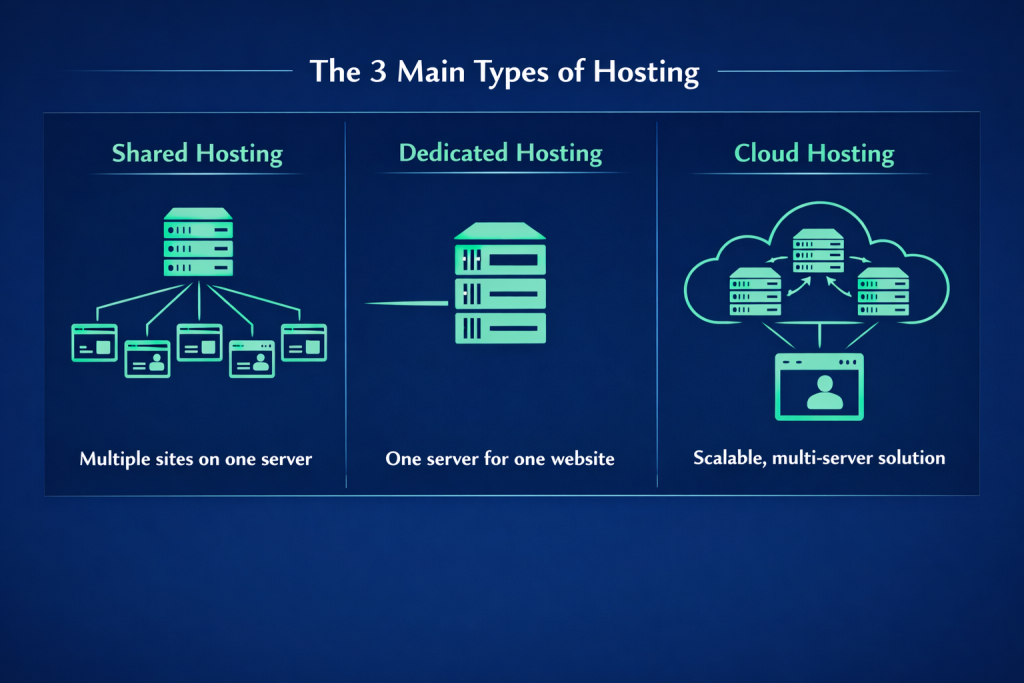
Hosting services are generally divided into a few main categories, each with its own pros, cons, and ideal use cases.
Shared Hosting
In this model, the resources of a single server are shared among multiple websites. It’s the most economical option and is perfect for small websites or beginners. However, because resources are shared, your site’s performance can be affected by other sites on the same server. Mixal’s Canada web hosting plans are a great starting point.
Dedicated Hosting
Dedicated hosting means you get an entire physical server to yourself. All of its resources—CPU, RAM, and storage—are exclusively yours. This is the best choice for large, high-traffic websites or for those who need complete control and security over their server environment. With a dedicated server Canada solution, you can install any software and configure the server exactly as you wish. For those who want the power without the price tag of a full bare metal server, a dedicated vps can be an excellent compromise.
Cloud Hosting
Cloud hosting ensures your website is always online and fast. Resources are intelligently distributed across multiple interconnected servers. If one server fails, others instantly take over. This makes cloud hosting incredibly flexible and scalable, able to grow right alongside your business. If you’re looking for a reliable, high-speed, and worry-free solution for a high-traffic project or a growing startup, cloud hosting is the perfect fit.
Matching the Host to Your Business
For Large, High-Traffic Businesses
Websites receiving over 100,000 visits per day should be looking at dedicated hosting solutions. These sites require immense hardware resources to handle requests from a large user base. Shared hosting is not suitable for this scale; as traffic increases, you’ll face slowdowns and potential downtime. A dedicated server, where all resources are yours, provides the power and speed needed to deliver an exceptional user experience at scale.
Ready for ultimate power? If your business requires a dedicated environment, explore Mixal’s Dedicated Server Canada solutions. For more information, connect with our sales experts.
For Small and Growing Businesses
For websites with low-to-moderate traffic, shared hosting services are often a great fit. You can get a high-quality, affordable plan that meets your needs. These plans are designed to handle up to around 15,000 daily visits. If your website is growing, has moderate traffic, and you need a cost-effective solution, a high-quality shared or cheap vps server plan is an excellent choice.
For E-commerce Websites
E-commerce sites need powerful resources to host a large catalogue of products and data. They handle a high volume of daily visitors who are browsing and buying, so a fast and powerful host is essential. Furthermore, if you’re using a CMS like WordPress with WooCommerce, you’ll benefit from hosting that is specifically optimized for it.
1. The Best WordPress Hosting
A vps server wordpress plan is optimized specifically for the world’s most popular CMS. This optimization simplifies installation and ensures full compatibility with WordPress plugins. On these plans, fewer users share server resources, and the hardware is powerful and up-to-date. Speed, uptime, and security are paramount, with extra security layers designed to protect against common WordPress vulnerabilities.
2. The Best WooCommerce Hosting
For any online store built with the WooCommerce plugin, choosing a host optimized for it is a decision you’ll need to make sooner or later. WooCommerce sites are database-intensive, and any weakness in the hosting can lead to slow product searches and a frustrating user experience. WooCommerce hosting delivers remarkable speed and is always available thanks to powerful hardware. It’s built to satisfy Google’s Core Web Vitals, which can play a significant role in improving your site’s SEO.
Building an online store? A hosting plan optimized for your platform is key. Check out Mixal’s high-performance WordPress Hosting and WooCommerce Hosting plans to get started.
Canadian Hosting vs. International Hosting: Does it Matter?
A common question is whether to choose a domestic host (in Canada) or an international one (in Europe, the US, etc.). The “location” of a host refers to the physical data centre where the server is located.
1. The Best Canadian Hosting Choosing a provider with data centres in Canada, like our vps hosting in canada, means your website is served from a Canadian IP address. For businesses whose audience is primarily in Canada, this is a huge advantage. The reduced physical distance between the server and the user results in lower latency and significantly faster load times. In recent years, the quality of Canadian server hardware and infrastructure has grown to be on par with the best in the world.
Targeting a Canadian audience? Give them the fastest possible experience with Mixal’s Canada Web Hosting.
2. The Best International Hosting Hosting located in European or US data centres often uses powerful, cutting-edge hardware. Google’s search crawlers may have slightly faster access to these servers, which can be a minor benefit for SEO. The main advantage, however, is for businesses with a global audience. Placing your server closer to the majority of your users, wherever they are, will improve their experience.
Serving a global market? Our European data centres provide a powerful and reliable foundation for your international presence. Explore Mixal’s Cloud Hosting plans today.

Conclusion
Everyone wants to find the perfect host—one that’s fast, powerful, and secure. While buying hosting can seem simple, a mistake in choosing the type of service, the amount of resources, or the provider can lead to significant problems down the road.
In this guide, we’ve walked through how to choose the best web hosting for different types of businesses. The key is to start with your needs. If you have a small, low-traffic business, an affordable shared plan is a great choice. For large websites with many users, a dedicated service offers the power you need. Pay close attention to the resources you select—RAM, storage space, and CPU—and remember that with a quality provider, you can always upgrade your plan as your business grows.
If you’re ready to take the next step, our team at Mixal is here to help you find the perfect, growth-focused solution.
Frequently Asked Questions
1. How do I determine how much storage space and bandwidth I need?
This depends on your site’s type, content volume, and visitor count. For new or simple websites, a basic plan is usually enough. As you grow, you can easily upgrade.
2. Can I upgrade my hosting plan in the future?
Yes. Reputable hosting companies like Mixal make it simple to upgrade your current plan or migrate to a different type of service without hassle.
3. What does “99.9% uptime guarantee” mean and why is it important?
A 99.9% uptime guarantee means the server should be offline for no more than about 8 hours over an entire year. This is a critical metric for maintaining a positive user experience and is important for SEO performance.
4. Does Mixal offer a free SSL certificate?
Yes, Mixal provides a free and easy-to-activate SSL certificate for most of our hosting plans, allowing you to secure your site with HTTPS in just a few clicks.
5. Which host is right for me?
High-Traffic Sites: Dedicated Hosting.
Moderate Traffic/Scalability Needs: Cloud Hosting.
E-commerce: WordPress or WooCommerce Hosting.
Personal/Small Sites: Shared Hosting. The choice also depends on your audience’s location (Canadian vs. International), your programming language, and your budget.
6. What factors influence the cost of hosting?
Location is a factor; Canadian hosting can sometimes be more cost-effective than international options with similar hardware. The hardware itself is a major factor—for instance, new-generation vps nvme ssd drives cost more than older SSDs. The web server software, control panel licenses, and the provider’s operational costs also play a role.