
Comparing shared hosting and cloud hosting is one of the best ways to truly understand the strengths and weaknesses of these two popular web services. By diving into their differences and recognizing their unique characteristics, you can make an informed decision and choose the host that best serves your website’s specific needs.
For many webmasters, purchasing the right host is a constant source of stress. The sheer variety of hosting services available today can make the selection process feel like a maze. Understanding the fundamental differences between cloud and shared environments helps you align your choice with your business requirements—whether that’s a strict budget, specific resource demands, high-level security, or the need for raw power and speed.
In this guide from Mixal, we’re going to look at how these two stack up across performance, security, speed, scalability, and accessibility.
Before you proceed you better to know what web hosting is.
Understanding Shared Hosting: Affordable and Collective Resources
To start, we have to ask: what exactly is shared hosting? In this model, the resources of a single physical server—such as storage space, RAM, bandwidth, and the CPU—are divided among several different websites. The number of sites on a single server depends on the hardware’s strength and the provider’s specific policies; a single server might host just a few sites or hundreds of them. Essentially, all these websites live under one roof, and their performance is tied to the collective power of that single machine and the limits the provider sets.
Shared hosting is incredibly popular among beginners and small businesses with low traffic because it is cost-effective, requires no technical maintenance on the user’s part, and is very easy to use. However, because you are sharing the “pipes” with other users, the activities of your “neighbors” can occasionally spill over and affect your site’s performance or security.
If you are looking to launch a site with a reliable provider, you can explore Mixal’s shared hosting services. We design our professional plans so that websites don’t negatively impact each other. By strictly limiting resource consumption, we ensure that even if one site experiences a traffic spike, the others remain stable. While some minor slowdown is natural in a shared environment during heavy loads, our Canada web hosting infrastructure is built to handle these demands gracefully.

Read More: What is Shared Hosting?
The Advantages of Shared Hosting
One of the primary reasons businesses choose shared hosting is the price. Because the costs of maintaining the server are split among many users, it is significantly cheaper than other hosting types. This makes it the ideal starting point for startups and small projects that don’t yet have a massive user base but need a professional online presence.
Another major benefit is the lack of technical overhead. You don’t need to be a systems expert to run your site. The hosting provider handles all the heavy lifting, including server installation, configuration, software updates, and hardware repairs. This allows webmasters to focus on their content rather than server maintenance. Furthermore, management is made simple through graphical interfaces like cPanel or DirectAdmin, making it accessible even for those with zero technical background.
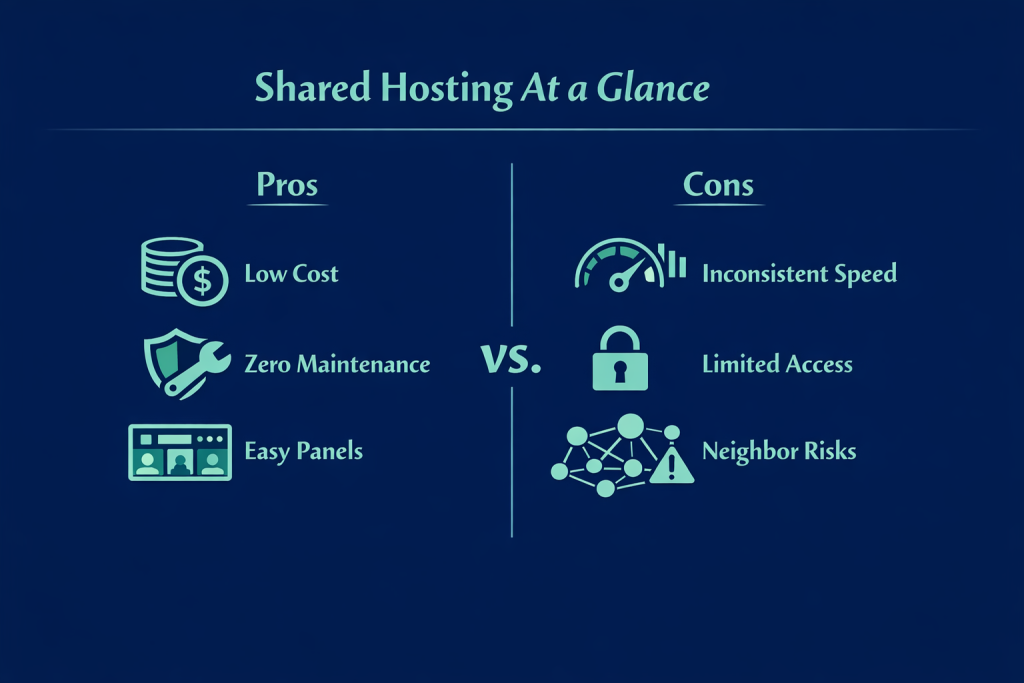
To summarize the advantages:
Low Cost: This is the biggest draw. By splitting the bill with other users, you get a functional website for a fraction of the cost of other services. It’s perfect for startups that don’t have a massive user base yet.
No Technical Maintenance: You don’t need to be a sysadmin. The provider handles all the installations, configurations, updates, and hardware repairs.
Easy Management: With graphical interfaces like cPanel or DirectAdmin, managing your email hosting canada or WordPress site is straightforward, even for those with no technical background.
The Disadvantages of Shared Hosting
Despite its perks, shared hosting has its limitations. The most notable weakness is performance; because resources are shared, page loading speeds can sometimes be inconsistent, which might impact user experience. Since all websites on the server are essentially competing for the same pool of resources, a surge in traffic on one site can occasionally slow down the others.
Flexibility is also a bit restricted. Shared hosting is a “ready-made” service, which is great for ease of use but limits your ability to customize deep server settings or install specialized software. You generally operate with “User” level access, which provides enough control for standard websites but might not satisfy advanced developers. Finally, while modern providers offer excellent security, the shared nature of the environment means that a vulnerability in one site could theoretically pose a risk to the broader server if not properly isolated.
In a glance the drawbacks are:
Performance Bottlenecks: Since resources are shared, your loading speeds might be inconsistent, which can hurt your user experience and SEO.
Limited Flexibility: These are “ready-to-use” environments. You have limited “User” level access, meaning you can’t customize deep server settings or install specialized software.
Security Risks: While modern virtualization makes them very safe, theoretically, a major breach on one site could pose a risk to the server environment if not managed by a reputable provider.
Understanding Cloud Hosting: Stable and Scalable Resources
Cloud hosting takes a different approach. Instead of relying on a single physical server, your website is hosted across a network of interconnected servers. In simple terms, the resources of several machines are provided to your site in parallel. This means your website isn’t “tethered” to one piece of hardware; if one server in the network fails or goes offline, others immediately pick up the slack, ensuring your site stays accessible.
It is important to note that while cloud hosting is technically a shared environment, its performance and capabilities are on a different level. It offers instantaneous scalability, allowing you to increase your resources—like RAM or CPU power—the moment you need them. If you’re looking for this kind of high-availability environment, you can check out Mixal’s cloud solutions to see how they can support your growth.
Read More: What is Cloud Hosting?

The Advantages of Cloud Hosting
The most striking advantage of the cloud is its unique performance. It is specifically designed to handle high-traffic websites with an efficiency that shared hosting simply can’t match. Because it draws power from multiple sources, it can scale rapidly as your user base grows. If you suddenly need more storage or a faster processor, the cloud can provide it almost instantly.
Reliability is another cornerstone of cloud hosting. It features “data redundancy,” which acts as a safety net; if one server fails, your data isn’t lost because it is mirrored across the network. This ensures high uptime and stability, which are critical for professional businesses. Additionally, cloud hosting offers more flexibility for personalization. Even with standard user access, you can often manage your resources and settings with more advanced tools than those found in basic shared plans.
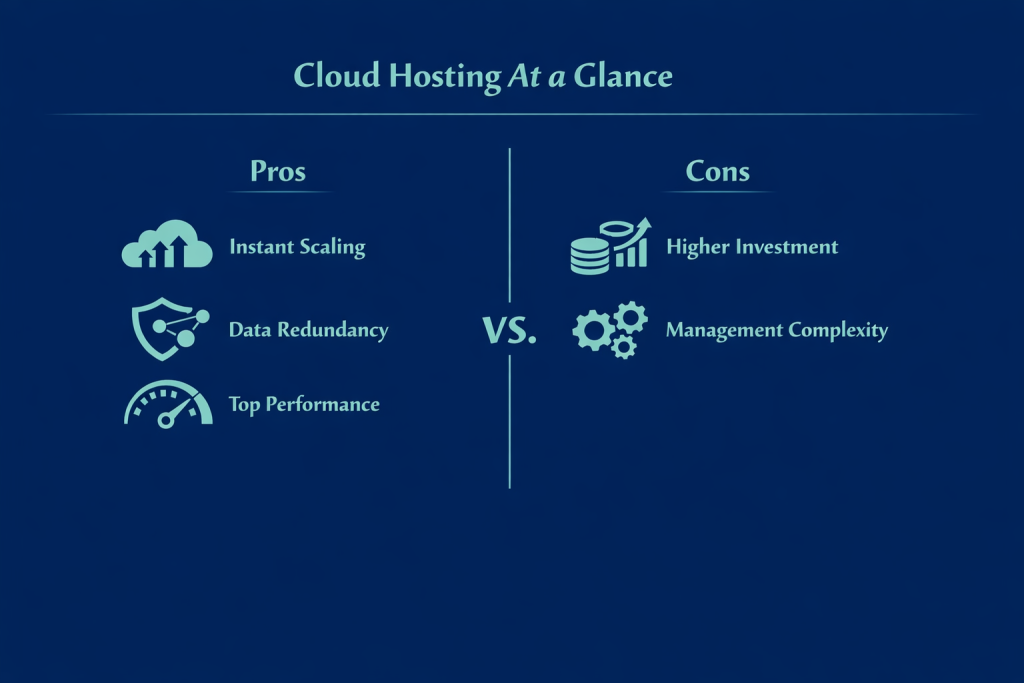
To summarize, the advantages are:
Top-Tier Performance: Designed for high-traffic sites, the cloud offers much faster speeds and better handling of concurrent requests compared to shared plans.
Reliability and Uptime: Data redundancy ensures that even if a server goes down, your site stays online. This high availability is the hallmark of the cloud.
Extreme Scalability: You can scale your RAM, CPU, or storage in real-time. As your business grows, your vps server cloud grows with you.
Customization: You generally get more flexibility in settings and configurations through your control panel compared to basic shared plans.
The Disadvantages of Cloud Hosting
The main hurdle for cloud hosting is the cost. Because you are accessing more advanced technology and a more stable infrastructure, you will naturally pay more than you would for a standard shared plan. While the “pay-as-you-go” model can be efficient, the base price might be too high for a brand-new hobbyist site on a shoestring budget. Additionally, managing data across a distributed network is more complex, so it is vital to choose a reputable provider like Mixal to ensure your security and performance are handled by experts.
To summarize, the disadvantages are:
Higher Cost: You’re paying for better technology and reliability. While you often “pay for what you use,” the base price is usually higher than shared hosting.
Management Complexity: Managing data across multiple servers can be more complex, which is why it’s vital to choose a reputable provider like Mixal that handles the heavy lifting for you.
Key Differences: Shared vs. Cloud
When we look at efficiency, cloud hosting is the clear leader. It provides the stable, fast resources necessary for a great user experience and better SEO. Shared hosting is perfect for small, low-traffic sites, but it can struggle to keep up if a site suddenly goes viral.
In terms of speed, the cloud wins again. Its high-power hardware and distributed nature mean lower latency and faster page loads. Shared hosting can be slower because the server is often running near its full capacity to support all its users. Similarly, for uptime, the cloud’s multi-server architecture offers a level of reliability that a single-server shared host can’t guarantee.
Security in the cloud is handled through multiple layers of protection, from identification controls to encrypted algorithms. While shared hosting is very secure when managed by a pro, it still carries the inherent risk of being on a single machine with other users. Finally, regarding price, shared hosting is the budget king, while cloud hosting is a performance investment where you pay for the specific resources you consume.
Comparison Summary Table
| Feature | Shared Hosting | Cloud Hosting |
| Resources (CPU/RAM) | Shared across one server | Shared across multiple strong servers |
| Storage (SSD/NVMe) | Shared | High-speed and Redundant |
| Network/Bandwidth | Limited Shared | High Volume / Scalable |
| Access Level | Limited User (Control Panel) | User (Enhanced Personalization) |
| Security | Basic Provider Managed | Advanced Multi-layer Protection |
| Technical Knowledge | Very Low | Low to Moderate |
| Price | Very Affordable | Moderate / Resource-based |
| Scalability | Low (Requires plan change) | High (Instantaneous) |
| Uptime/Reliability | Average | Very High (Redundant) |
Final Thoughts
“The best” hosting is entirely subjective—it depends on your business. If you are just starting out with a small blog or a personal site and have a limited budget, shared hosting is a fantastic and cost-effective choice. But if you are running a high-traffic site where every second of downtime costs money, cloud hosting is the way to go.
At Mixal, we offer both. Whether you need to buy a domain name canada, set up email hosting canada, or launch a vps linux server, our team is here to help you find the perfect balance of price and power.
Ready to upgrade your online presence? Explore Mixal’s canadian vps hosting and cloud services today to give your website the foundation it needs to thrive.
Further Reading: How Website Speed Impacts Your Bottom Line