

Whether you are an IT manager scaling up a massive enterprise or a business owner looking for rock-solid security, understanding how a private cloud operates is absolutely essential. Let’s dive right into what it is, how it works, and whether it’s the right fit for your next big leap.
What Is a Private Cloud?
A private cloud is a specific model of cloud computing where the entire infrastructure and all its resources are dedicated exclusively to a single organization. Think of it like owning a detached house in Toronto rather than renting a condo; you don’t share the hallways, the plumbing, or the security systems with anyone else.
This model offers a significantly higher level of security, control, and customization compared to a public cloud. Because of this isolated environment, it is the go-to choice for highly sensitive sectors like banking, large-scale corporate enterprises, and government agencies. Your private cloud can be hosted right in your own on-site data centre, or it can be exclusively hosted for you by a dedicated third-party provider.
Ultimately, this tier of cloud computing allows organizations to harness all the incredible benefits of cloud technology—like rapid scalability and flexible resource allocation—without compromising on strict security standards or regulatory compliance. If your business is navigating tight legal frameworks, this is a brilliantly empowering solution.
Read More:
What Are the Use Cases for a Private Cloud?
A private cloud empowers organizations by handing them the keys to total control over their infrastructure, data, and security protocols. In the broader landscape of Canada web hosting, private clouds are the heavy lifters designed for specific, high-demand scenarios.
Elevated Data Security
Traffic within a private cloud is generally restricted to the organization’s internal transactions, which drastically elevates the security baseline. Public cloud providers, on the other hand, have to juggle the traffic and transactions of millions of users simultaneously, inherently increasing the risk of malicious cross-traffic. Thanks to its dedicated physical structure, a private cloud gives you granular control over your servers, networks, and application security.
Optimized Performance and Efficiency
Because the hardware is entirely dedicated to your operations, your workload performance becomes highly predictable. You are completely insulated from the “noisy neighbour” effect—meaning your bandwidth and infrastructure are never bogged down by another company’s sudden traffic spike.
Strict Regulatory and Supervisory Compliance
Navigating data privacy laws can feel like driving the DVP during rush hour—stressful and full of rules. Regulations like the European Union’s GDPR, or our own PIPEDA here in Canada, often dictate exactly where data must be physically stored and how it must be processed. In situations where public cloud providers simply cannot meet these stringent geographic or processing requirements, a private cloud becomes non-negotiable. Organizations handling highly sensitive legal or financial data rely on private cloud storage to maintain absolute, unyielding control over their information.
Tailored for Large-Scale Organizations
If you are running a massive, complex organization dealing with colossal volumes of data and intense computational needs, the private cloud is incredibly efficient and built to handle that exact kind of heavy lifting.

Benefits and Features of a Private Cloud
Building a private cloud gives any organization—especially those bound by strict regulatory frameworks—the golden opportunity to achieve total control and customization without ever sacrificing security.
First and foremost, it offers unparalleled visibility and control over your hardware and software choices. You aren’t boxed into a provider’s default stack; you can meticulously customize the exact hardware and software you need. This level of customization allows you to fine-tune your environment to your specific operational requirements, which ultimately drives up efficiency and can lead to significant long-term cost savings.
Security is another massive win. Private clouds are engineered with advanced, multi-layered security protocols specifically designed to shield sensitive data from unauthorized access or cyberattacks. Furthermore, because your resources are clearly allocated and dedicated, your costs remain stable and highly predictable. There are no surprise bandwidth overages at the end of the month, making financial forecasting a breeze.
Disadvantages and Challenges of a Private Cloud
Of course, with great power comes a fair bit of responsibility. Implementing and maintaining a private cloud can carry a hefty price tag, and it demands a high level of technical expertise to manage the infrastructure properly. Unlike the near-infinite, instant expansion you get with a public cloud, scaling a private cloud requires deliberate planning and often new physical investments, which can limit your immediate flexibility.
Before taking the plunge, it’s vital to assess your resources honestly. Let’s break down the main hurdles. The initial setup and ongoing maintenance require substantial capital investment in hardware, software, and specialized IT personnel. Management is complex because your team is solely responsible for every single infrastructural detail. Scalability is limited; spinning up new resources isn’t as simple as clicking a button—it requires strategic planning and procurement. Consequently, because the infrastructure is custom-built for your current needs, adapting to rapid, unexpected shifts in the business landscape can be slower than if you were on a public cloud.
Here is a quick breakdown comparing the pros and cons:
| Feature | The Advantage | The Challenge |
| Control & Management | Complete authority over infrastructure; full hardware/software customization. | Requires specialized expertise and significant resources to manage and maintain. |
| Customization | Ability to tailor the environment precisely to the organization’s unique needs. | Implementation and ongoing infrastructure management can be highly complex. |
| Security | Advanced, dedicated security layers to protect highly sensitive data. | Building and maintaining these bespoke security measures can be very expensive. |
| Compliance | Seamless alignment with legal requirements and strict industry standards. | Demands continuous, rigorous monitoring to ensure ongoing compliance. |
| Costs | Stable, predictable monthly expenses due to fixed resource allocation. | High initial capital expenditure required for setup and deployment. |
| Performance | Optimized, reliable performance with minimal latency or unexpected downtime. | May struggle to instantly adapt during sudden, massive spikes in workload traffic. |
| Modernization | Easier integration with existing legacy systems and older applications. | Modernizing those legacy apps for the cloud requires dedicated time and resources. |
| Scalability | Capable of scaling when more resources are deliberately added. | Adding or reducing resources is slower and more restrictive compared to public clouds. |
How Does a Private Cloud Work?
In a private cloud ecosystem, your organization utilizes specialized management tools to allocate resources, monitor system performance, and enforce security measures. This architecture allows you to enjoy the flexibility of cloud computing while keeping a firm grip on the steering wheel.
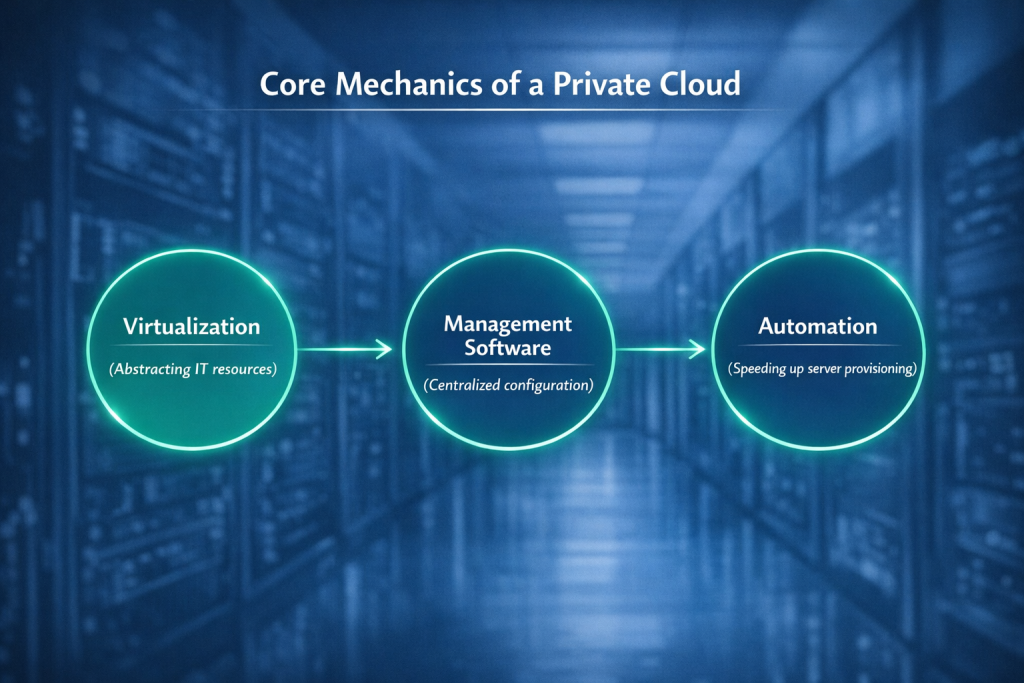
The mechanics of a private cloud rely heavily on three core components. First is virtualization. This technology abstracts IT resources from their physical hardware, creating virtual versions that users can interact with. It’s what allows you to spin up a vps linux server or a windows vps server within your own environment. Next, you have management software. Network administrators need centralized platforms to configure equipment, secure the perimeter, and optimize resource allocation. Finally, automation technologies tie it all together. Automation speeds up processes like server provisioning and resource integration while drastically reducing human error, which is absolutely critical for a smooth-running private environment.
Private Cloud Architecture
The architecture of a private cloud is a bespoke blend of hardware and software designed exclusively for your organization. It combines virtualization, private networking, and dedicated storage to give you absolute dominion over your resources.
You generally have a few architectural paths to choose from. You can opt for a fully managed, on-premises solution run by your own IT team, or have it managed entirely by a third party. When it comes to the physical setup, you can use a traditional infrastructure—where storage, servers, and networking are separate physical entities—or a Hyper-Converged Infrastructure (HCI) that bundles all these resources into one streamlined system. Furthermore, just like public clouds, your private cloud can be structured to deliver different service models, such as Infrastructure as a Service (IaaS), Platform as a Service (PaaS), or Software as a Service (SaaS).
Types of Private Cloud
Not all private clouds are built the same. Depending on who manages it and where it physically lives, we can categorize them into four main types. Finding the right fit depends entirely on your team’s capabilities and your business goals.
On-Premises Private Cloud
This is the traditional route. The cloud is hosted internally within your organization’s own data centre and managed by your in-house IT team. It offers the absolute highest level of control over data privacy, security, and customization, but your overall capacity is strictly limited by the physical hardware you own.
Virtual Private Cloud (VPC)
A VPC is a fascinating middle ground. It provides isolated, private environments using the shared infrastructure of a public cloud provider. You get to define and control a custom virtual network that behaves exactly like a private cloud, allowing you to run workloads securely and separately from other organizations, without buying the physical servers yourself.
Hosted Private Cloud
With this model, your cloud lives off-site on the servers of a third-party vendor. The key here is that you aren’t sharing resources with anyone else; the servers are dedicated entirely to you. It feels a lot like a massive, enterprise-grade canadian vps hosting environment. You usually get excellent scalability, a user-friendly dashboard, and a dedicated support team, while the provider handles the physical maintenance, security patching, and hardware updates.
Managed Private Cloud
Often hosted in a single-tenant environment (though it can be deployed on-premises), a managed private cloud shifts the burden of deployment, configuration, and daily operations to a third-party provider. They handle the software, network, and operational heavy lifting, and often bundle in extra services like identity management, disaster recovery, and automated backups.
Comparing Private Cloud to Other Cloud Services
To make an informed deployment decision, you need to understand how the private cloud stacks up against public and hybrid models.
While a private cloud gives you total control and places the burden of cost and maintenance squarely on your shoulders, a public cloud shares resources across thousands of clients, keeping costs low and relying on Service Level Agreements (SLAs) to guarantee security.
Then there is the Hybrid Cloud—a beautiful compromise that connects public and private infrastructures into one flexible ecosystem. In a hybrid setup, you can choose the optimal environment for every single application. To pull this off, you need robust orchestration tools that allow workloads to move seamlessly between the two environments based on performance needs, budget, and security requirements.
Here is a quick comparison of the three main cloud deployments:
| Feature | Private Cloud | Public Cloud | Hybrid Cloud |
| Data Control | Complete, absolute control over all data. | Data is stored on shared infrastructure. | A strategic mix of control across both environments. |
| Security | Highly customized, top-tier security. | Security is standardized and guaranteed via SLAs. | Requires complex security coordination between environments. |
| Cost Responsibility | Organization bears all setup and maintenance costs. | Costs are shared and usually pay-as-you-go. | Costs fluctuate based on the utilization of both environments. |
| Scalability | Limited by physical hardware capacity. | Virtually unlimited, instant scalability. | Highly scalable by offloading to the public cloud when needed. |
| Flexibility | Lower flexibility for sudden, rapid changes. | High flexibility and agility. | Maximum flexibility; choose the best environment per workload. |
| Resource Usage | 100% dedicated to one organization. | Shared among multiple tenants. | Leverages both dedicated and shared resources. |
| Deployment | Requires deep technical expertise and time. | Fast, simple, and user-friendly deployment. | Requires advanced orchestration and integration tools. |
Who Is a Private Cloud Right For?
A private cloud isn’t for everyone, but for the right organization, it is a game-changer. It is highly recommended for massive enterprises that need to process and manage colossal volumes of data daily. It is also the standard for sensitive industries—like healthcare, finance, and government—where data security and regulatory compliance are simply non-negotiable.
If your company requires highly specific hardware configurations or custom performance tuning that public providers won’t accommodate, a private cloud is your answer. It is also perfect for privacy-centric organizations that refuse to share physical server space with third parties, and for scaling businesses that want to manage their vast resources with absolute precision. Just like when you first decided to buy Canada domain name to establish your brand, moving to a private cloud is about taking total ownership of your digital real estate.
Important Tips for Buying a Private Cloud
If you’ve decided that the security and control of a private cloud are exactly what your business needs, here are a few critical tips to keep in mind before signing any contracts:
First, rigorously assess your needs. Map out your exact requirements so you know the infrastructure you are buying can actually handle your workloads. Next, scrutinize the security. Ensure your chosen provider utilizes top-tier security protocols to protect your assets. Be very clear on the costs—both the initial setup and the ongoing maintenance—to ensure it aligns with your long-term budget.
Don’t overlook technical support; you want a provider with a highly responsive, expert support team ready to jump in the moment an issue arises. Finally, ensure compatibility. Your new cloud needs to play nicely with your existing legacy systems, custom apps, and everyday tools like your standard email hosting canada, so you don’t have to rebuild your workflow from scratch.
Seamless Migration with Mixal
Here at Mixal, we believe in empowering your growth. By migrating to a Mixal private cloud, you gain a secure infrastructure perfectly tailored to your unique business needs, paving the way for your success with maximum stability and optimized costs.
With Mixal, you can expand the cloud capacity of your traditional data centre without the headache of purchasing new hardware. We allow you to deploy your applications and cloud architecture in an environment that mirrors your existing setup. This means you can smoothly transition to the cloud while maintaining your familiar workflows, ultimately reducing overhead and boosting your team’s productivity.
Let Mixal help you build a secure, dedicated, and fully customized foundation. We give you the tools to manage your most sensitive data with absolute authority, ensuring your business consistently exceeds expectations. If you are looking for a dedicated vps or a robust enterprise solution, our team is here to make it happen.
Conclusion
To wrap things up, a private cloud is a powerful computing model that grants organizations the ability to manage their IT resources in a completely dedicated, highly secure environment. By providing exclusive access to all hardware and software resources, it hands you total control over your data and infrastructure, making it an incredible asset for businesses that prioritize security and performance above all else.
Frequently Asked Questions
How can I strengthen the security of my private cloud?
Implementing advanced firewalls, robust intrusion detection systems, end-to-end data encryption, and strict access controls will significantly boost your security posture. (I also highly recommend checking out our dedicated articles on cloud security for a deeper dive!)
Is it possible to transition from a private cloud to a public cloud later?
Absolutely! In fact, many organizations adopt a hybrid cloud model, which allows them to seamlessly utilize and bridge both private and public cloud services simultaneously.
How do I actually set up a private cloud?
Setting one up from scratch requires purchasing the appropriate enterprise hardware, acquiring cloud management software, and hiring a specialized technical team. Alternatively, you can partner with a trusted private cloud provider—like us here at Mixal—to handle the heavy lifting for you!