

If you’ve been keeping an eye on the hosting world lately, you’ve probably noticed that “the cloud” is no longer just a buzzword—it’s the engine driving the modern web. In fact, research shows that cloud hosting usage jumped by over 33% in 2023 alone.
But what exactly is it, and why is everyone making the switch? Here at Mixal, we’re all about empowering you with the right tech. In this latest educational blog post, we’re breaking down what cloud hosting is, how it works, and whether it’s the right fuel for your next big project.
Cloud hosting is an advanced web hosting service based on—you guessed it—cloud computing. Unlike traditional hosting, which relies on the resources of a single physical server, cloud hosting uses a vast network of interconnected virtual servers to host your website.
Think of this distributed structure as the ultimate safety net. Because you’re essentially tapping into the power of multiple servers simultaneously, your site stays live even if one of those servers hiccups. It’s a setup designed for high availability and seamless growth. Whether you are looking for canadian vps hosting or a flexible cloud environment, this infrastructure is built to keep you online no matter what.
Read More: What is Web Hosting?
How Does Cloud Hosting Actually Work?
Cloud hosting relies on a process called virtualization. Just like a vps linux server, a virtual layer is created on top of the physical hardware where your data and content are stored. These virtual layers can be replicated across a network of servers spread out globally.
To make it simple, imagine an Olympic relay team. Each server is like an athlete with a specific job. If one runner gets a cramp or trips (a server failure), the “bench” is full of teammates ready to jump in instantly and finish the race. In cloud hosting, if one server goes down for any reason, the others are ready to step in immediately so your visitors never notice a glitch.
Key Features of Cloud Hosting
While the concept is simple, the technical specs are what really make it attractive for IT managers and dev teams:
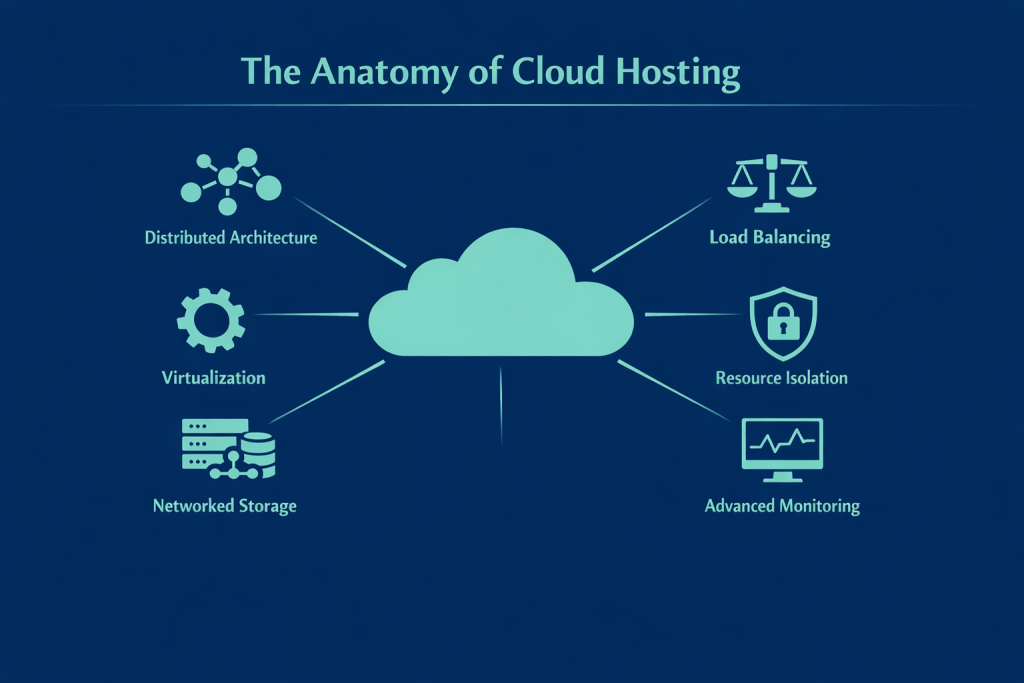
Distributed Architecture: Unlike a single physical box, cloud hosting is built on a “Cluster” of interconnected servers. Your site lives on a network of virtual resources made up of multiple physical “Nodes.”
Virtualization: This is the heart of the operation. Using technologies like a Hypervisor, physical server resources are split into smaller, isolated units called Virtual Machines. This allows for precise resource allocation.
Networked Storage: Your data doesn’t just sit on one hard drive; it lives on a networked storage system. This makes data transfers lightning-fast and significantly boosts security.
Advanced Monitoring: Cloud data centres are monitored 24/7. If a hardware component like RAM or a CPU fails on one Node, your virtual machine automatically migrates to a healthy Node in the cluster—something standard hosting just can’t do.
Load Balancing: Systems like a Load Balancer intelligently distribute incoming traffic across the cluster. This prevents any single server from getting overwhelmed, ensuring your site stays stable even during massive traffic spikes.
Resource Isolation: Whether you’re using a vps server wordpress setup or a complex app, your resources are isolated. What other users do on the network won’t impact your site’s performance or security.
The Big Wins: Why Go Cloud?
Why are so many businesses moving their canada web hosting to the cloud? It comes down to a few major advantages:
Insane Scalability: Cloud hosting is the “warm host” for high traffic. You can add resources on the fly to handle sudden viral moments, then scale back down to save money.
Superior Performance and Stability: With near-perfect uptime and load balancing, your customers get a much better experience.
Cost-Efficiency: You stop paying for “ghost” resources. With the “pay-as-you-go” model, you only pay for what you actually use. No more buying massive hardware you don’t need yet.
Fast Backup and Recovery: Cloud hosting is a hero when it comes to data protection. Backups are simpler, and recovery is fast, so you never have to worry about losing your hard work.
Speed to Market: Traditional IT setups require waiting for hardware to be shipped and tested. With the cloud, you can integrate new tech and deploy environments in minutes, helping you outpace the competition.
Fortress-Level Security: Top-tier providers keep their systems patched and updated with the latest security frameworks, often including data recovery as a standard feature.
Pro Tip: The best part? You only pay for what you use. You don’t need to buy a giant bare metal server before you’re ready. You can scale up or down as your business grows, ensuring you never overpay or run out of juice.
The Trade-offs
While the pros definitely outweigh the cons, there are a few things to keep in mind. You do have less “low-level” control over the underlying physical infrastructure. Also, if your resource settings aren’t optimized, costs can creep up.
| Pros of Cloud Hosting | Cons of Cloud Hosting |
| Incredible Scalability | Dependency on the service provider |
| Higher Performance & Stability | Less control over physical infrastructure |
| Cost-Effective Pricing | Potential for higher costs if misconfigured |
| Fast Backup & Recovery | Requires high technical knowledge for full config |
| High Security & Constant Updates | Generally more expensive than basic shared hosting |
Read More: Cloud Hosting Pros and Cons
Common Use Cases of Cloud Hosting
Is cloud hosting actually what you need? Let’s look at where it shines:
Variable Traffic Sites: If you run a seasonal business or launch big marketing campaigns, the cloud scales with you so you don’t crash during peak hours.
Infrastructure as a Service (IaaS): Perfect for technical teams who want full control over the OS and software while Mixal handles the heavy lifting of the physical hardware.
Platform as a Service (PaaS): Ideal for developers. Instead of messing with OS installs, you get a ready-to-go environment so you can just focus on your code.
Software as a Service (SaaS): The simplest form—think Trello or Gmail. You just use the software through a browser, and the cloud handles everything else.
Types of Cloud Hosting
Public Cloud: Resources are shared among multiple clients—great for startups and general projects.
Private Cloud: Dedicated entirely to one organization—perfect for banks or hospitals needing maximum security.
Hybrid Cloud: A mix of both, letting you keep sensitive data private while using the public cloud for everyday tasks.
Specialized Options: Whether it’s vps linux server setups, windows vps server environments, or specialized python hosting, there is a cloud flavor for every stack.
Read More: What is Private Cloud Hosting?

Who is Cloud Hosting For?
High-Traffic Websites: News sites and large e-commerce stores that need dedicated processing power and bandwidth.
Web App Developers: Those who need the flexibility to scale as their user base grows.
Fast-Growing Startups: Founders who need to know their site won’t crash the moment they go viral.
WordPress Power Users: If your site is getting sluggish, a vps server wordpress setup on the cloud provides the speed and stability you’re missing.
Email Marketing Pros: For those who need a rock-solid canada email hosting solution with high deliverability and advanced spam filters.
Cloud vs. Traditional Hosting: The Quick Breakdown
| Hosting Type | Resource Allocation | Performance | Scalability | Best For |
| Shared Hosting | Shared with others | Limited | Fixed | Small personal blogs |
| VPS Hosting | Dedicated portion | Stable | Moderate | Medium businesses |
| Cloud Hosting | Highly Dynamic | Exceptional | Unlimited | High-traffic/Growing sites |
| Dedicated Server | Entire physical box | Highest | Limited by hardware | Large enterprises |
Read More:
The Mixal Solution
At Mixal, our mission is to deliver exceptional, growth-focused hosting solutions that empower individuals and businesses. We offer a range of cloud hosting options with various resource levels to fit your goals. You can even try our cloud servers for free with a test run!
Our public cloud is the perfect launchpad for startups and small businesses, offering professional management and high flexibility. For larger organizations, banks, or those handling sensitive data, our private cloud services give you total command over your infrastructure.
If you’re looking for high speed, 99% uptime, and the ability to buy domain name canada services and pair them with a powerful backend, Mixal is here to help. Whether you need a vps nvme ssd for raw speed or a debian vps server for stability, we provide the infrastructure that grows with you.
Conclusion
Cloud hosting is a massive leap forward from expensive, rigid physical servers. It’s faster, more reliable, and scales as fast as your ideas do.
Public Cloud: Affordable, scalable, and easy to access.
Private Cloud: Secure, customizable, and totally under your control. In the end, the choice depends on your specific goals and budget.
Frequently Asked Questions
What is Cloud Hosting? It’s a service that uses multiple servers simultaneously to ensure your site is always fast and online.
How is it different from Shared Hosting? Shared hosting puts everyone on one server. Cloud hosting gives you access to a whole network of resources.
What should I look for in a provider? Focus on resource limits (RAM/CPU), data centre location (like canadian vps hosting), and the quality of their 24/7 support.
What is Cloud Email Hosting? It’s a secure way to manage your organization’s emails using a distributed network, ensuring your inbox is always accessible and easy to scale.