
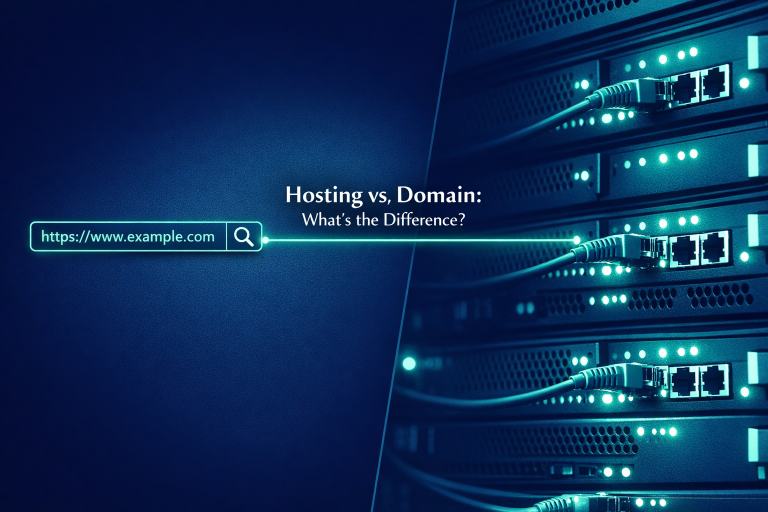
Welcome back to another educational blog post on the Mixal blog. Today, we are tackling a foundational topic that trips up almost every newcomer to the web development world: the difference between hosting and domains.
You can think of the difference between a domain and web hosting much like the difference between a store’s street address and the physical building itself. The domain is the address that guides customers to your location. However, the store itself—the physical space where your products sit and where you serve your customers—is your web host.
In this article, we’ll break down four key differences to clearly explain what sets a host and a domain apart, and why you absolutely need both to launch a website. If you’ve ever found yourself confused by these two terms while looking into Canada web hosting, this guide is exactly what you need to clear things up!
What is the Difference Between Hosting and a Domain?
Simply put, a domain is the internet address that allows users to find your website, whereas hosting is the physical storage space for your website’s files. Let’s go back to our earlier metaphor: the internet address (domain) is the signpost and street address, while the hosting is the actual brick-and-mortar building.
Behind the scenes, every domain is tied to a specific numerical label known as an IP address. When you decide on a name for your website, your first step is to check if that domain is available. If no one else has claimed it, you can register your desired name through a domain registrar.
So, what exactly is hosting in this context? Hosting is the service that stores and maintains your website’s files. Once your domain name is approved and linked, the hosting company’s servers are what actually deliver your website’s content to the user’s screen.
| Feature | Web Hosting | Domain Name |
| Definition | The storage space for your site’s data on a server. | The internet address users type to access your site. |
| Primary Use | Hosting files, databases, images, and code. | Directing users’ browsers to your website. |
| Types/Variations | Shared, Dedicated, Cloud, vps server wordpress, etc. | Generic (.com, .net), Country (.ca), New (.online). |
| When to Buy | After choosing a domain, or simultaneously. | At the very beginning of launching your site. |
| Modifiability | Easy to upgrade resources or change plans. | Can be transferred, but the name itself cannot be edited once registered. |
What is Hosting and What Does it Do?
Web hosting is essentially a dedicated space on a highly powerful computer (a server) that is constantly connected to the internet. This space stores your website’s files, images, databases, and all other essential data. When a user types your web address into their browser, the browser uses the domain to connect to this storage space, downloading the necessary files to display the website on the user’s screen.
The primary purpose of hosting is to provide a stable, secure, and always-online foundation for storing and delivering your web content to visitors.
Mixal: Providing Top-Tier Hosting Solutions
Here at Mixal, we leverage advanced data centres and cutting-edge hardware to provide the best possible hosting environments for your projects. Whether you’re looking for a simple shared plan or robust web hosting in canada, we have you covered. Check out our plans and pricing to find your perfect fit!
Suggested Reading: What is Web Hosting?

What is a Domain and What Does it Do?
A domain (or domain name) is the unique, human-readable address that users type into their browser’s URL bar to access your website—for example, mixal.com. Domains were invented as a simple, memorable alternative to IP addresses, which are long strings of numbers that computers use to identify each other on the network.
The main job of a domain is to guide users directly to your website. But it does more than that; it acts as your brand’s identity on the web. It plays a massive role in recognition, building trust, and overall branding. Furthermore, domains are essential if you want to set up professional email hosting in canada (like [email protected]) or link to various other online services.
Secure Your Brand with Mixal
Registering a domain is the very first step toward going global and growing your business. If you’re looking to buy domain name canada from a reliable and accredited registrar, Mixal is your go-to destination.
Suggested Reading: What is Domain?

The Difference in Performance and Efficiency
From a technical standpoint, domains and hosting play entirely different but highly complementary roles in keeping a website running.
The domain acts as a human-friendly directory. When a user types your domain into their browser, the Domain Name System (DNS) acts like the internet’s phonebook, translating that memorable name into the specific IP address of the server where your website lives.
The host, on the other hand, is where the heavy lifting happens. It holds the actual content—your HTML, CSS, images, and databases. The server hosting your site receives the user’s request, processes it, and sends the requested data back across the internet to the user’s browser.
To put it simply: the domain is the route, and the host is the destination. Without connecting your domain to your web host, there is no way to display your site. Conversely, even if you own a great domain name, without a hosting plan, your site simply won’t exist online.
Differences in Structure and Types
Domains and hosting are built on completely different structural components.
A domain consists of two main parts. First is the Second-Level Domain (SLD), which is the part you choose to represent your brand (like “mixal” in mixal.com). The second part is the Top-Level Domain (TLD), which is the extension at the end. These extensions are generally divided into generic TLDs (gTLDs like .com, .net, .org) and country-code TLDs (ccTLDs like .ca for Canada or .uk for the United Kingdom).
Hosting, however, is built on physical or virtual servers that allocate resources like storage space, RAM, CPU, and an operating system to your website. Your data is stored on the server’s hard drives and served to users via web server software like Apache or Nginx.
Hosting is usually categorized by its operating system (like a vps linux server or a windows vps server) or by the type of environment it provides:
Shared Hosting: Multiple websites share the resources of a single physical server. It has limited resources but is the most affordable entry point.
Virtual Private Server (VPS): A physical server is partitioned into several virtual servers, giving you dedicated resources. This is fantastic for growing sites.
Cloud Hosting: A vps server cloud setup uses a network of interconnected servers. If one server experiences an issue, another instantly takes over, ensuring maximum uptime. This is the gold standard for sites that cannot afford to go offline.
WordPress Hosting: An environment specifically optimized for WordPress, offering enhanced security and performance for the platform.
Suggested Reading:
How to Buy Hosting and a Domain to Launch Your Site
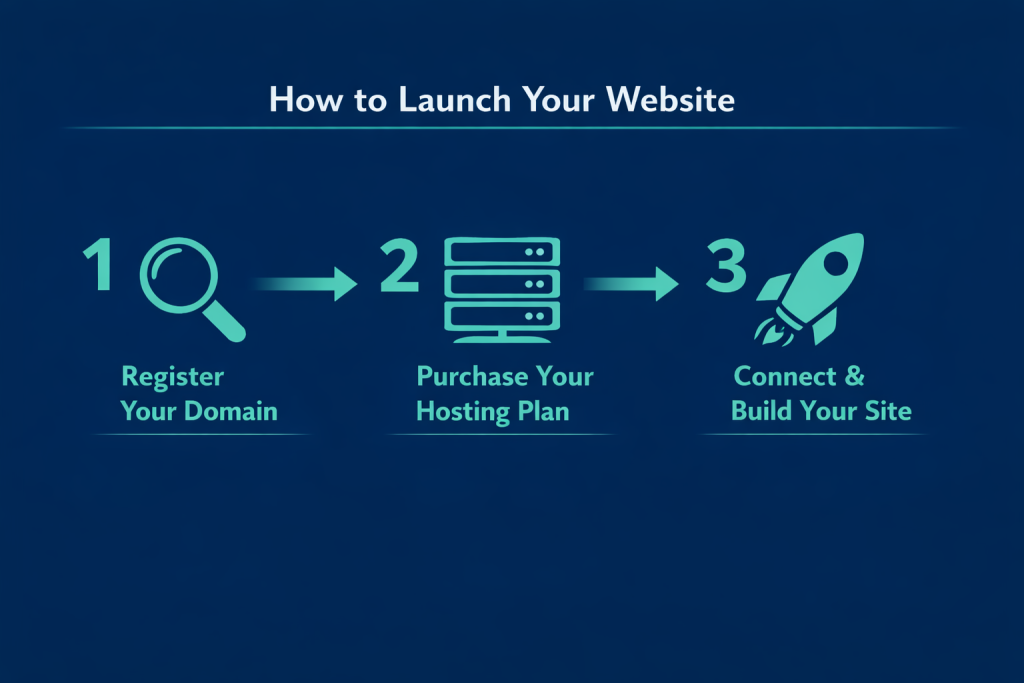
As we’ve established, you need both pieces of the puzzle to get online. Just as building a house requires securing a plot of land and getting an address before you start building, launching a website follows a logical three-step process:
First, brainstorm and select your desired domain name, ensuring no one else has registered it. Once you find the perfect fit, register it.
Second, purchase your hosting plan from a reliable provider like Mixal. If you aren’t sure what resources you need, our expert team is always available for a free consultation to point you in the right direction.
Finally, once you’ve connected your domain to your hosting account, you can install a platform like WordPress and begin building and customizing your website to your exact specifications!
Crucial Tips Before You Buy
Before you pull out your credit card, keeping a few key points in mind can save you from technical headaches and branding missteps down the road.
Always start by vetting the reputation of the company you are buying from. Look for strong technical support, a solid track record, and clear refund policies. When picking your domain, keep it short, memorable, and relevant to your brand. Avoid hyphens or numbers if possible, as they confuse users. Furthermore, pick a TLD that matches your audience; if you are a local Toronto business, a .ca extension is highly recommended to build local trust.
When evaluating hosting, be realistic about your needs. A simple blog won’t need the same RAM and CPU as a bustling e-commerce store. Don’t fall into the trap of buying underpowered, cheap web hosting if you expect high traffic. Finally, consider server location. If your audience is primarily in North America, choosing a server located in Canada or the US will ensure the fastest possible page load times for your visitors.
What is the Price Difference?
There is a significant difference in how domains and hosting are priced. Generally speaking, hosting is an ongoing, higher cost because you are paying for physical hardware, maintenance, bandwidth, and technical support. A domain, on the other hand, is simply the registration of a name, which requires much less overhead and is usually a lower annual fee.
Hosting prices fluctuate wildly based on the type of service (shared vs. cloud), the allocated resources, and the server’s location. Domain prices depend on the extension (a .ca is often priced differently than a .com) and the registration period.
It’s also worth noting the existence of “Premium Domains.” These are short, highly brandable, or keyword-rich domains that have already been registered. Because of their immense marketing value, they are sold on the aftermarket for prices ranging from hundreds to thousands of dollars, far exceeding the cost of a standard cheap domain registration.
Which is the Best Site to Buy From?
Choosing a provider from a sea of options can feel overwhelming. However, you really only need to look for three core features: 24/7 professional support, a diverse range of scalable plans, and transparent, fair pricing.
Keeping these pillars in mind, Mixal stands out as one of the most reliable cloud and web hosting providers available. With state-of-the-art infrastructure, a wide array of tailored products, and lightning-fast support, we are proud to be the trusted choice for countless businesses and developers.
Conclusion
To wrap things up, while domains and hosting are entirely separate concepts—one being your digital address and the other your digital real estate—they must work together seamlessly to bring your website to life.
The easiest way to kickstart your online journey is to secure both from a single, reputable company. At Mixal, you can search for your dream domain and pair it with the perfect hosting plan in one go. And remember, if you ever feel stuck, our support team is just a ticket or phone call away, ready to offer free advice to ensure your project’s success.
Frequently Asked Questions
1. What is the difference between hosting and a domain?
It comes down to definition and function. The domain is your website’s internet address, while the hosting is the physical server space where your website’s files are stored.
2. After registering a domain, can I transfer it to another host?
Absolutely. You own your domain name, and you can point it to or transfer it to any hosting provider you choose at any time.
3. Can I edit or change my domain name after I buy it?
No. Once a domain is registered, the name itself cannot be altered. If you want a different name, you will need to register a brand new domain. (If you do this, ensure you set up proper redirects so you don’t lose your SEO rankings!).
4. If I buy hosting, do I still need to pay for a domain?
It depends! Sometimes, a hosting provider will give you a free subdomain (like yourname.mixal.com) to get started, but for a professional appearance, registering your own custom domain is highly recommended.
5. Can I launch a website with just a domain and no hosting?
No. A domain is just an address. Without hosting, there is no server to hold your files, meaning there is nothing for visitors to see when they arrive at your address. You need both to have a functioning website.